
INTRODUCTION

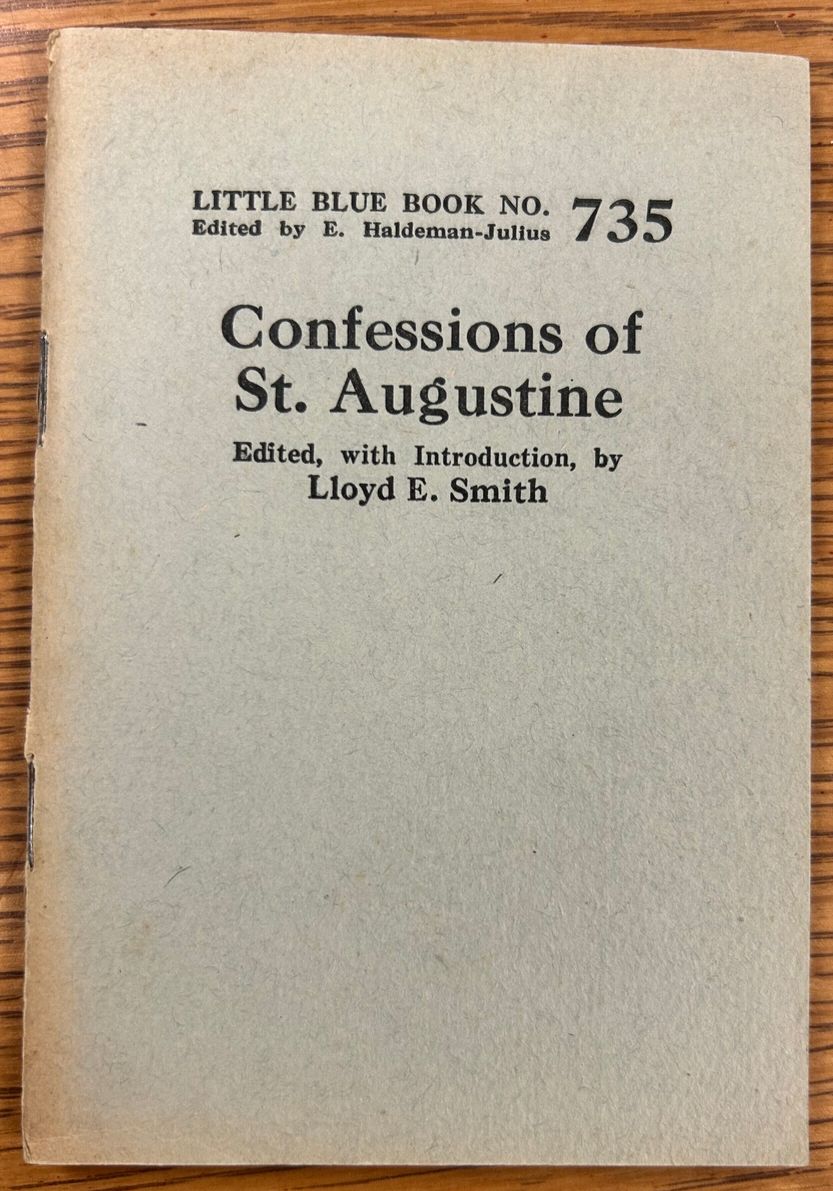
Saint Augustine, “one of the four great fathers of the Latin Church,” was born in what is now Algeria (North Africa), November, 354 A. D. His mother was a devout Christian, but his father was unconverted at the time of Augustine’s birth. The piety of the mother finally won both father and son to the Christian faith.
Augustine’s early life, especially his youth, was characterized by sinful lapses into the evils of temptation, temptation to which he often yielded, for which weakness he has chastised himself mercilessly in his Confessions . His self-condemned wickedness did not prevent his being a determined student, however, and he was carefully trained to become a teacher of rhetoric. At nineteen, his mind was stirred by Cicero’s Hortensius to seek the truth, but he wandered aimlessly about in the mazes of various schools of thought without adopting any one of them, good or bad. Manicheism (a religious philosophy in which goodness and light, identified with God, were in conflict with evil and chaos, identified with the powers of darkness) attracted Augustine, until he became an enthusiastic exponent of its doctrines. He hoped that his own dark path of sensuality might be directed to the light by the influence of this oriental system (Manicheism originated in Persia and had a bright coloring of eastern myth), but he had not acquired sufficient moral strength to enable him to attain his ideal of chastity and temperance. Because it did not lead him out of his evil ways, as he had hoped, Manicheism gradually weakened in its sway over him. Then, too, Augustine was well-versed in the exact sciences, and so found it impossible to coordinate the superstitions of Manicheism with known facts.
Augustine, became a teacher of grammar, was, by all accounts, an excellent instructor. He returned to his birthplace, and, while teaching there, secured the lasting friendship of Alypius. Staying here about a year—the chief happening, besides his friendship with Alypius, being a vision of his mother comforting her for her son’s lack of faith, described in the Confessions ( III , xi )—Augustine went back to Carthage, and from there to Rome. This was in 383; but Rome, since his interest in Manicheism was on the wane, held little attraction for him, so he accepted a position as teacher of rhetoric at Milan.
Now openly separated from Manicheism, Augustine turned to Skepticism (Pyrrhonism: disbelief in all doctrines and principles derived from either the reason or the senses; the judgment was to be kept in aloof non-committal on all subjects) temporarily, and from that to Neo-Platonism (involving that all matter was evil, that all ideas were emanations from the mind of God, that human reason was in affinity with Divine reason, that the soul was to be redeemed by separation from matter, and that the human reason was to be absorbed in the divine by “continuous contemplation;” it professed a trinity composed of the One, Intelligence, and the Soul) which gave him his first hint of a God minus materialism: invisible, eternal, and changeless. A devout preacher of Milan further influenced him in this trend toward faith, and his battle with the curse of sensuality that was upon him became an intolerable conflict within him.
His struggle toward truth culminated in one poignant moment of realization, which he has described in the Confessions ( VIII , xii , 30). This conversion occurred in 386, when he withdrew, accompanied by several friends, to a country place near Milan and offered himself as a candidate for baptism. Augustine’s mother rejoiced at this fulfilment of her vision, and, when she was dying soon after this realization of her life-long hopes, her last hours of life were made happy by her son’s Christian understanding. The account of their companionship in the Confessions ( IX , x-xi , 23-28) displays Augustine’s “literary power at its highest.”
Unwilling to assume religious responsibility in any official capacity too soon, Augustine, within a year, was persuaded to become presbyter of Hippo (now Bona, Algiers), and about 395 he became coadjutor to the bishop, and subsequently bishop of the see. The remaining years of his life were occupied with his ecclesiastical duties, and by prolific writing, which was largely controversial. His Confessions , consisting of an autobiographical record of his spiritual conversion and growth, are his most famous achievement, and were written about 397. Probably his greatest work, from the point of view of intellectual as well as literary power, is the City of God , begun in 413 and continuing over a period of thirteen years, which was planned as an elaborate treatise “in vindication of Christianity and the Christian Church.” In 427 he wrote the Retractions , which are a review of all his literary work, and include revisions, corrections, explanations, etc., to bring them all into line with the maturity of mind to which he had then attained. A work entitled The Trinity occupied him for some thirty years, and was not, as most of his writings were, inspired by the strife of religious controversy, but was the result of steady growth by contemplation in the author’s pious mind. These four, here named, are by no means all that Augustine wrote, but they serve to indicate his remarkable devotion and energy in his life of faith, a faith which came to him, a self-flailed sinner, as a remarkable sign of redemption.
Augustine died, sick and weary, while the Vandals were besieging Hippo, in 430, at seventy-five years of age. He did not live to see the city in the hands of its conquerors. “None can deny the greatness of Augustine’s soul—his enthusiasm, his unceasing search after truth, his affectionate disposition, his ardor, his self-devotion. And even those who may doubt the soundness of his dogmatic conclusions, cannot but acknowledge the depth of his spiritual convictions, and the logical force and penetration with which he handled the most difficult questions, thus weaving all the elements of his experience and of his profound scriptural knowledge into a great system of Christian thought.” (Gustav Krüger.)
The present edition has been based on the translation of E. B. Pusey, which first appeared in 1838, and of which Pusey speaks in his Preface: “The Confessions of St. Augustine have ever been a favorite Christian study. St. Augustine says of them himself, ‘The thirteen books of my Confessions praise God, Holy and Good, on occasion of that which has in me been good or evil, and raise up man’s understanding and affections to Him: for myself, they did so while they were being written, and now do, when read. Let others think of them, as to them seems right; yet that they have and do much please many brethren, I know.’” Pusey says further: “The subject of the Confessions would naturally give them a deep interest, presenting, as they do, an account of the way in which God led perhaps the most powerful mind of Christian antiquity out of darkness to light, and changed one who was a chosen vessel unto Himself from a heretic and a seducer of the brethren, into one of the most energetic defenders of Catholic Truth, both against the strange sect to which he had belonged, and against the Arians, Pelagians, and semi-Pelagians, Donatists, Priscillianists. Such, not an autobiography, is the object of the Confessions ; a praise and confession of God’s unmerited goodness, but of himself only so much as might illustrate out of what depth God’s mercy had raised him.”
Looking for comments…
Searching Nostr relays. This may take a moment the first time this article is opened.
Looking for comments…
Searching Nostr relays. This may take a moment the first time this article is opened.